
Engineering an Enterprise Security
Platform That Builds Trust at Scale
In the security industry, your digital presence is your first line of authority. Red Wolf Security operates across eight integrated protection verticals — from armed guarding to smart home systems — and needed a web platform capable of communicating that depth of capability to corporate, residential, and institutional clients simultaneously.
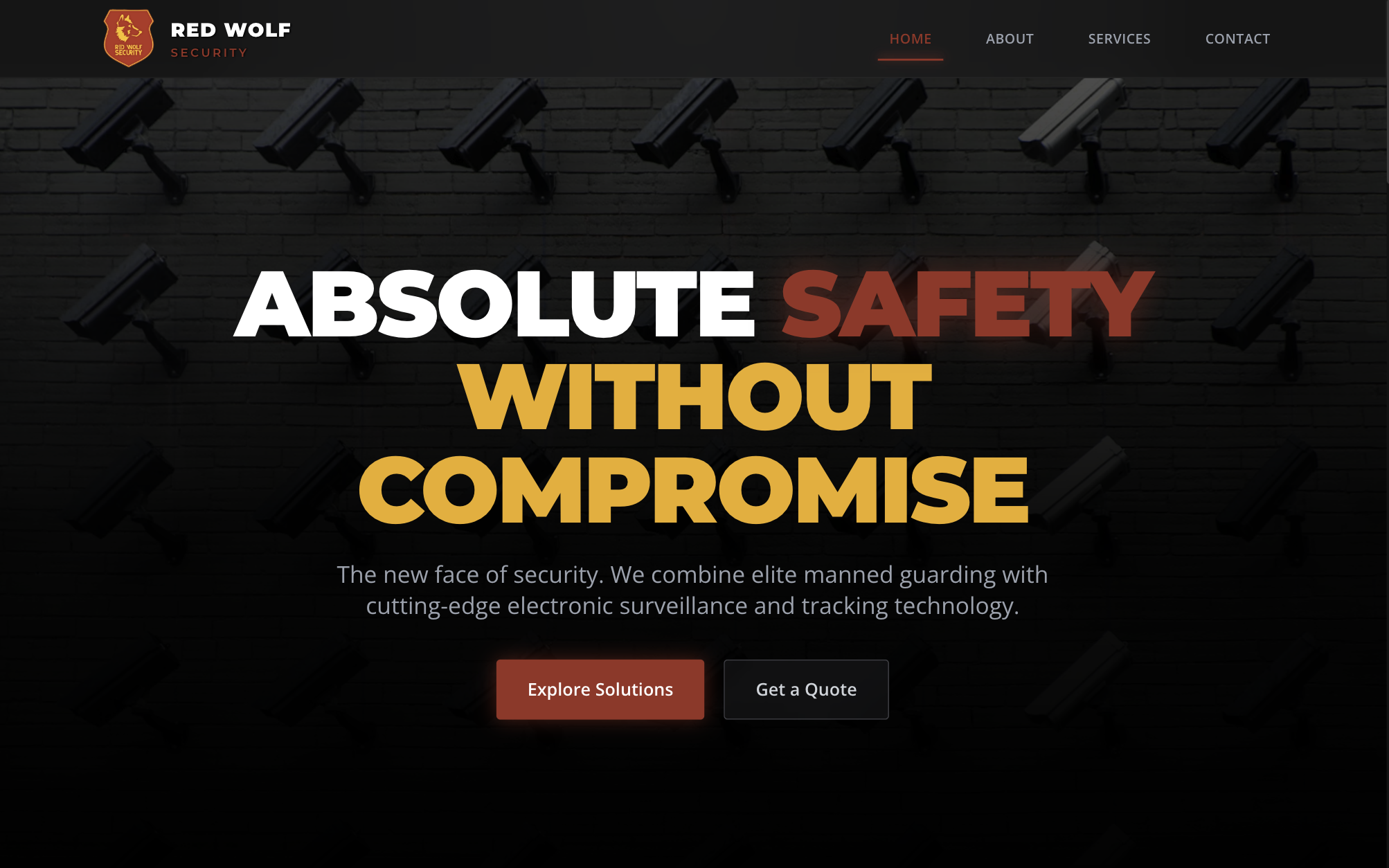
Authority, Precision, and Trust — The Three Pillars of Security Industry Digital Presence
The security industry operates in a high-stakes trust environment. When a corporate client, government institution, or residential community evaluates a security provider, they are not just assessing service specifications — they are making a judgment about whether they can trust this company with the protection of people, assets, and infrastructure. That trust evaluation begins digitally, often before a phone call is made or a proposal requested. Red Wolf Security's existing platform wasn't performing that trust-building function at the level its operational capability warranted.
Red Wolf Security's integrated service model — combining physical security, electronic surveillance, access control, vehicle tracking, smart home systems, investigation services, fire detection, and IT consulting — is both a significant competitive advantage and a complex communication challenge. Nexora was engaged to architect a digital platform that could communicate all eight verticals with appropriate depth, serve three distinct client segments (corporate, residential, institutional) simultaneously, and establish the visual authority that the security sector demands.
- Build an enterprise-grade security platform that communicates authority and operational capability from first impression
- Architect a service presentation system capable of handling 8+ integrated verticals without creating navigation complexity or visual confusion
- Design trust-building UX systems that reduce the psychological barrier to inquiry in a high-commitment purchasing environment
- Deliver a performance-optimised platform that maintains its authority regardless of device or connectivity conditions
Eight Service Verticals. Three Client Segments. One Platform That Has to Make All of It Credible.
The complexity of Red Wolf Security's challenge is not immediately obvious until you attempt to solve it. Most corporate websites are built to communicate one primary value proposition to one primary audience. Red Wolf Security needed a platform that could present eight distinct security disciplines — each with its own technical language, client profile, and deployment context — to three different audience segments, in a way that felt coherent rather than fragmented and authoritative rather than overwhelming.
Multi-Vertical Service Communication Without Information Overload
A corporate client evaluating guarding and rapid response services has entirely different information needs from a residential client enquiring about smart home automation or a facility manager researching fire detection systems. Presenting all eight service verticals on a single platform risks creating a "we do everything" perception — which paradoxically undermines confidence in any individual service. The information architecture needed to communicate specialisation within each vertical while simultaneously communicating the integration advantage of the full suite.
Trust Under High Purchase Stakes
Security services represent a high-commitment, high-consequence purchase. Clients don't switch security providers casually — the decision involves contractual commitments, operational dependencies, and genuine risk if the provider underperforms. This means that the UX challenge is not just converting visitor interest to inquiry: it is reducing the psychological friction of making first contact in a context where the client knows that inquiry may lead to a significant business relationship. The platform had to be structured to make that first step feel low-risk.
Brand Differentiation in a Commoditised Market
The Nigerian security industry is fragmented. Many operators present similarly — generic service lists, undifferentiated visual language, and minimal evidence of operational capability. Standing out in this environment required more than a better design — it required a platform structured to demonstrate capability through evidence (case applications, service depth, technical specificity) rather than asserting it through marketing claims.
"In security services, trust is not given — it is earned through demonstrated capability. Every element of the platform was designed to show rather than tell: technical depth over marketing claims, operational evidence over brand promises, clear authority over confident assertion."
Audience Segmentation as the Architectural Foundation
Nexora's strategy for Red Wolf Security began with a rigorous audience segmentation exercise. The three primary client segments — corporate (enterprises and institutions), residential (individual and community clients), and industrial (facilities, logistics, and manufacturing) — have distinct security priorities, different decision-making cycles, and different language registers they use to evaluate providers. The information architecture, service grouping, and CTA design were all differentiated by segment to serve each audience appropriately without forcing any of them to navigate content built for another.
Service Hierarchy Architecture: Integration, Not Fragmentation
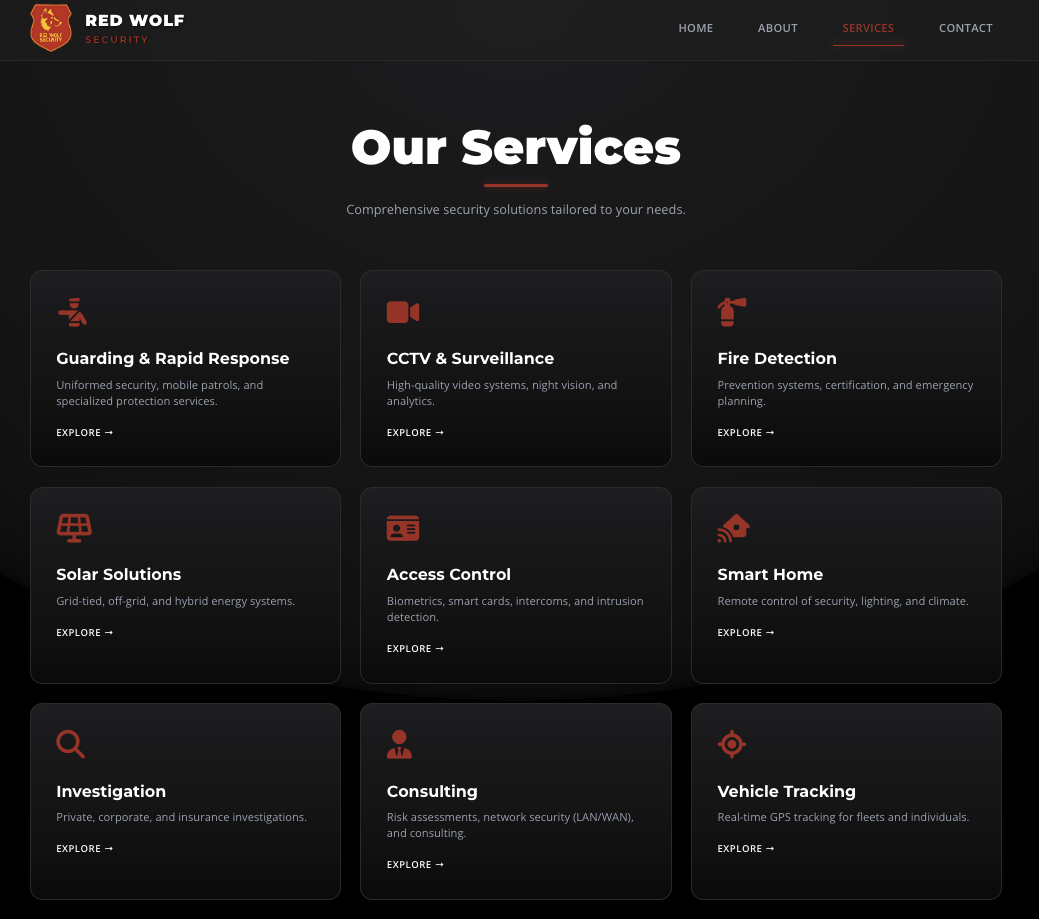
The service presentation strategy resolved the multi-vertical communication problem through a two-tier hierarchy. At the homepage level, services were presented as integrated capability pillars — physical security, electronic systems, intelligence and investigation, smart technology — with each pillar grouping related verticals. At the service detail level, each individual service received its own page with technical depth, deployment context, and relevant client segment indicators. This structure allowed a corporate client arriving from search to land directly on a relevant service page, while a visitor browsing the homepage could understand the full integrated offering before drilling into specifics.
Evidence-Led Trust Architecture
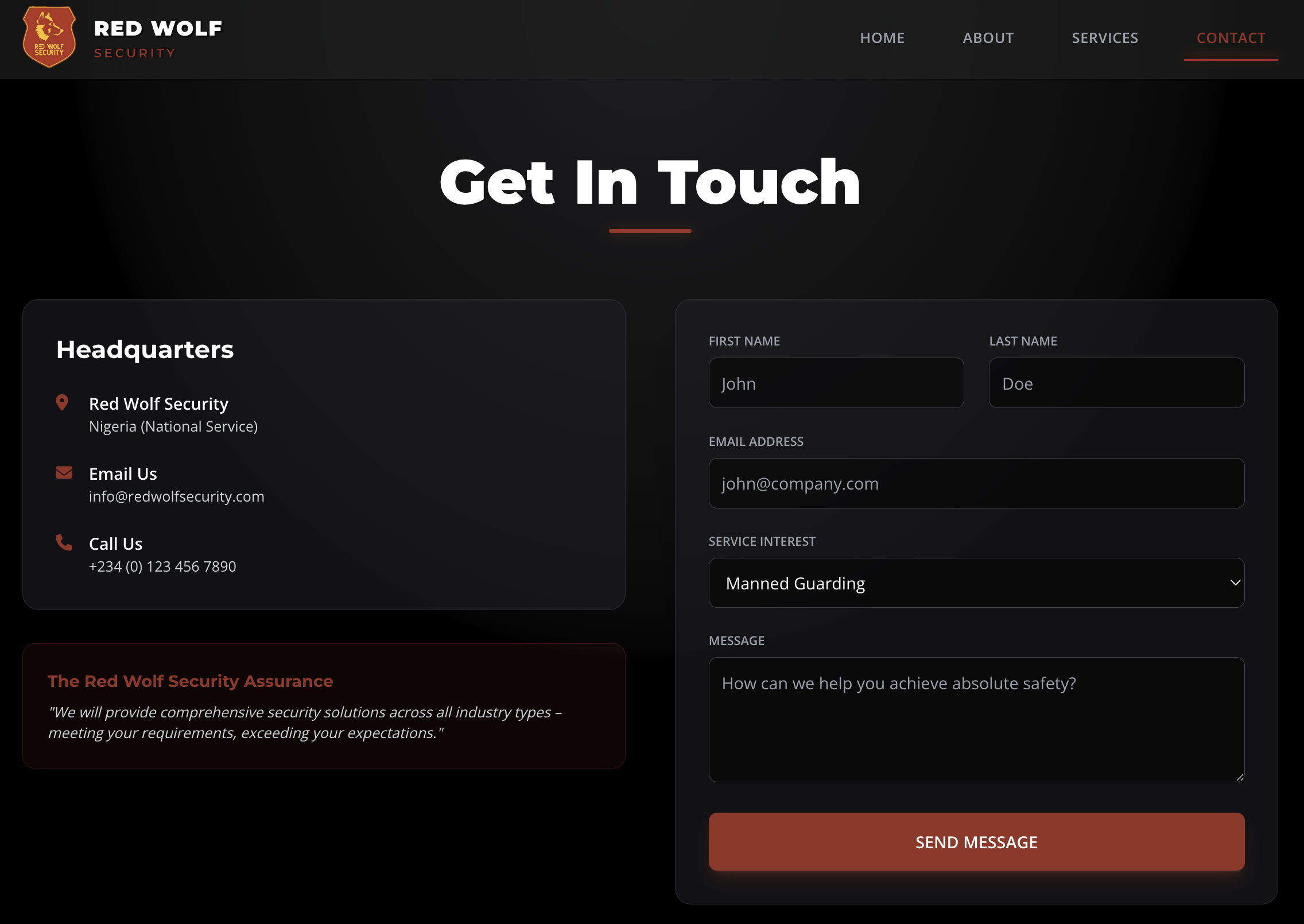
Rather than relying on marketing language to establish credibility, the trust architecture was built around operational evidence: service specifications that demonstrated technical depth, deployment scope indicators that communicated scale of operation, and client-type indicators that allowed prospects to see their own situation reflected in the platform's content. The inquiry pathway was designed to reduce psychological commitment — multiple low-friction entry points (call, email, form) rather than a single high-commitment form, allowing prospective clients to initiate contact at their own comfort level.
Our Process
Client Segment Mapping & Security Industry Research
Analysis of the three distinct client segments — corporate, residential, industrial — their security decision-making processes, evaluation criteria, and information requirements. Competitor audit of the Nigerian security sector digital landscape.
Service Architecture & Multi-Vertical Information Design
Strategic structuring of eight service verticals into a navigable, coherent architecture — service pillars at the homepage level, individual service depth at the page level — without creating information overload or navigation complexity.
Enterprise Security Visual Identity & UI/UX Design
Visual system designed for authority, precision, and controlled tension — dark, confident, technically precise. UI components calibrated for the information density required by a multi-service security platform without compromising navigability.
Frontend Development & Responsive Engineering
High-performance frontend built for consistent experience across corporate desktop environments and mobile devices, with particular attention to the information-dense service pages maintaining clarity on small screens.
CMS Integration, Analytics & Lead Infrastructure
WordPress CMS architecture with service-specific content types, multi-channel inquiry routing, and analytics event tracking to monitor service page engagement, contact method preferences, and lead source attribution.
Precision, Control, and Authority — An Enterprise Security Aesthetic
The visual language for Red Wolf Security was built around a single emotional objective: controlled authority. Security brands that communicate aggression or urgency create anxiety; security brands that communicate professionalism and precision create confidence. The design system was calibrated for the latter — a visual environment that makes a prospective client feel that they are dealing with an organisation that operates with the same precision and control it promises to deliver in the field.
Colour System
Typography
The typographic system was chosen for technical authority over consumer appeal. Display headings used a bold, geometric sans-serif — confident, modern, machine-precise — appropriate for a company that deploys sophisticated electronic and physical security systems. Body copy used a clean, high-legibility typeface at sizes that accommodate the information density required by detailed security service descriptions without compromising readability. Service category labels used a condensed, technical variant to reinforce the specialised, operational register of the content.
Design Principles
Authority Through Density
Security clients expect technical depth. The design system was built to handle high information density without visual chaos — structured grids, careful typographic hierarchy, and component systems that allowed detailed service specifications to be presented in a way that felt organised rather than overwhelming.
Trust Through Evidence
Visual trust signals in security design don't come from stock photography of padlocks. They come from the quality of the information itself — technical specificity in service descriptions, deployment scale indicators, and the structural sophistication of the platform as a whole. The design system was built to make evidence feel prominent rather than buried.
Controlled Tension
Security brands operate in an emotional register that requires careful calibration. The design needed to communicate urgency without anxiety, strength without aggression, and confidence without arrogance. The red accent — used sparingly against dark surfaces — signalled alert and authority without dominating the visual environment.
Structured Discovery for a High-Stakes, High-Complexity Service Portfolio
The UX challenge for Red Wolf Security was structurally different from consumer-facing design problems. The platform's visitors weren't making impulse decisions — they were conducting structured research in a high-stakes context. The UX system needed to support that research process: giving visitors the tools to understand the full service portfolio efficiently, identify the specific services relevant to their situation, and reach the appropriate contact pathway without friction. Research facilitation, not persuasion, was the primary UX goal.
Homepage: Scope Communication in Under Sixty Seconds
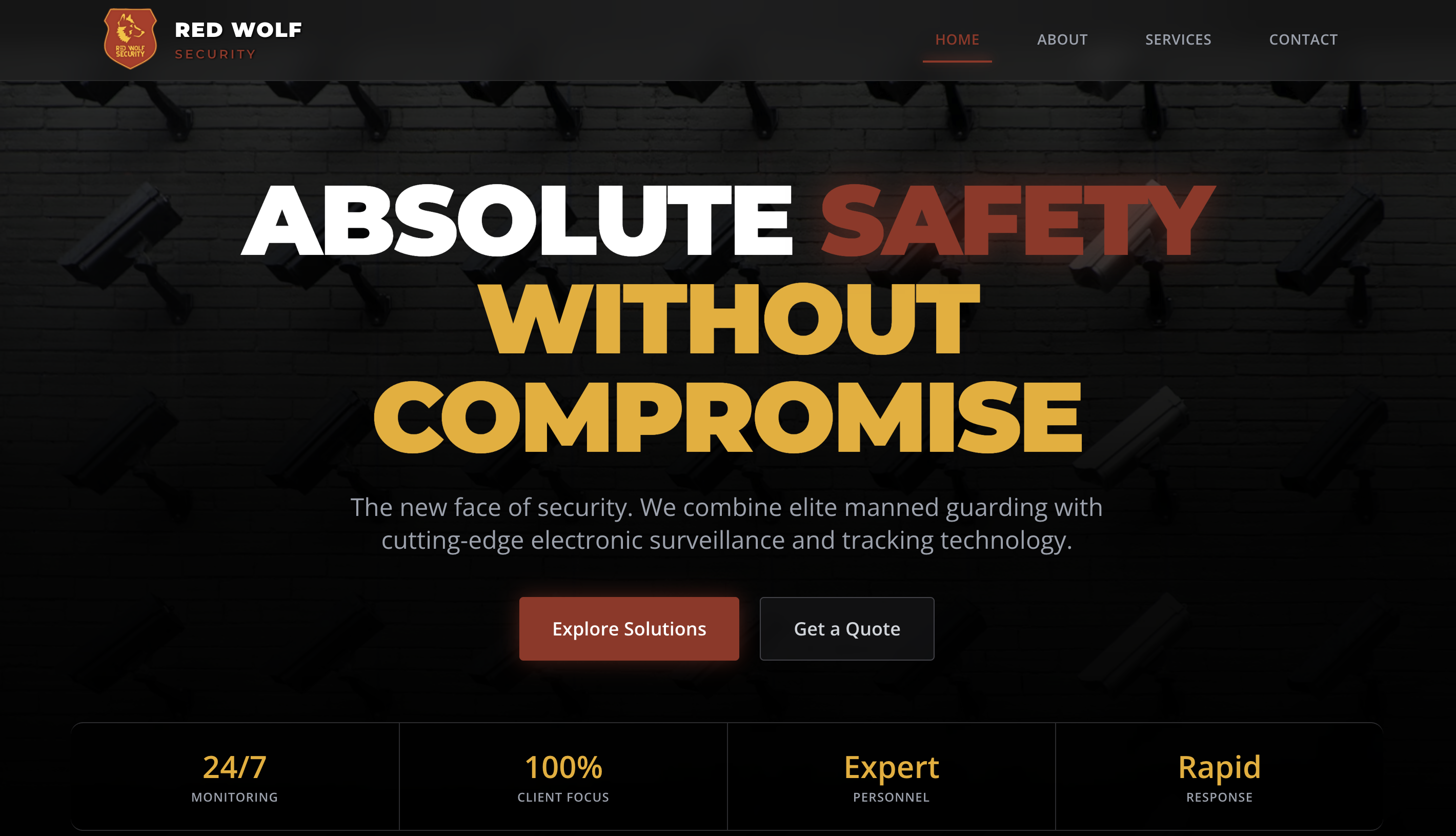
The homepage was structured to communicate the full scope of Red Wolf Security's integrated capability within sixty seconds of a typical visitor's first interaction. Service pillars — Physical Security, Electronic Surveillance, Intelligence & Investigation, Smart Technology — were presented visually with concise capability summaries, enabling a quick scan that revealed the breadth of the operation before a visitor committed to deeper exploration. The hero section established brand authority; the service overview established operational scope; the CTA infrastructure established accessibility.
Service Pages: Technical Depth for Evaluating Audiences
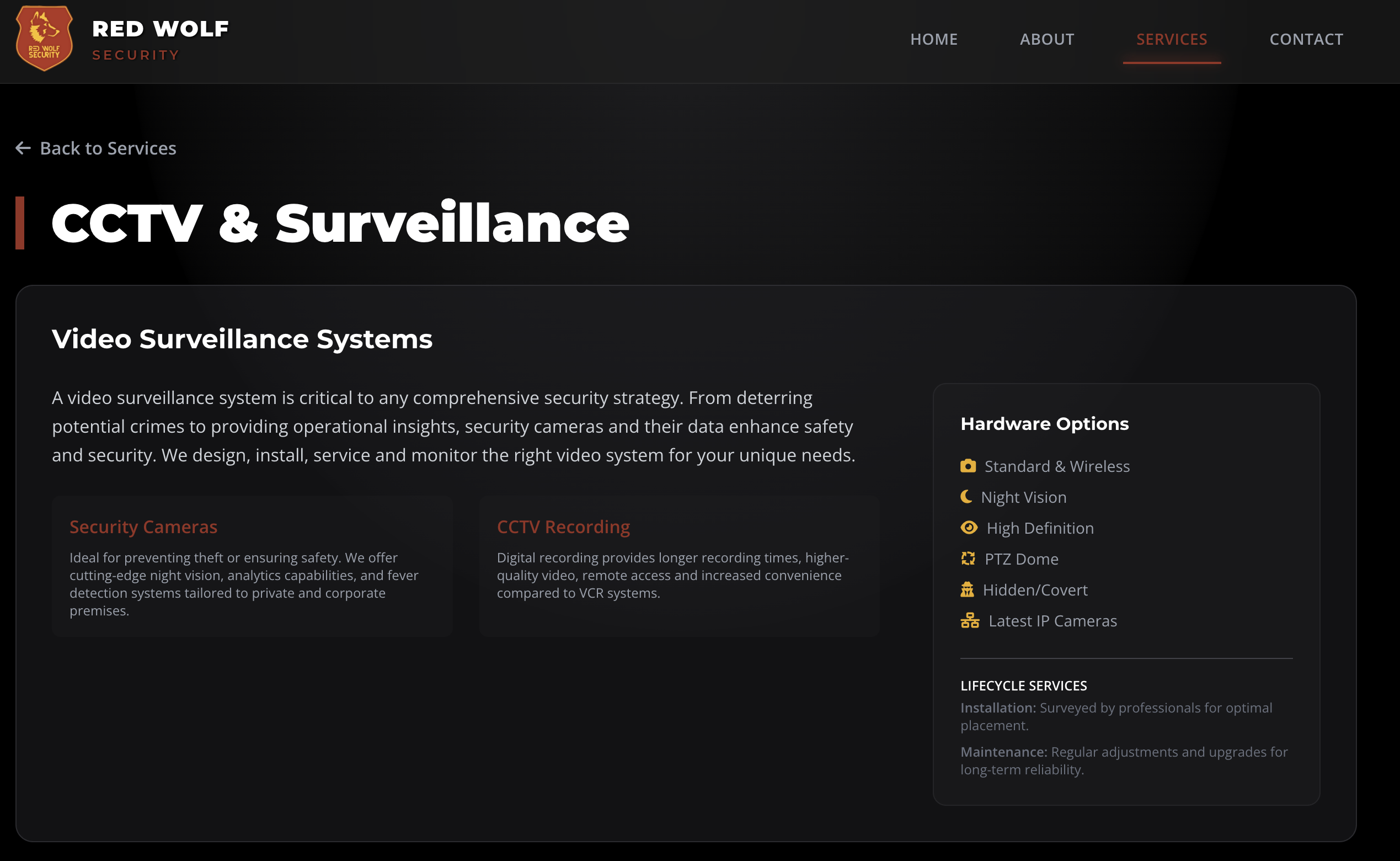
Individual service pages were architected for the evaluating visitor — someone who has identified a service category as relevant and wants to understand capability depth before deciding whether to make contact. Each service page moved from scope (what the service covers) to technical approach (how it's delivered) to deployment context (who it's appropriate for) to next step (how to enquire). This structure allowed a technically sophisticated buyer to assess the company's capability rigorously without Nexora needing to simplify the content for a non-technical audience — both could extract what they needed from the same page.
Multi-Channel Inquiry Architecture
Security clients contact providers in ways that vary by urgency and preference. Corporate procurement may prefer a formal inquiry form with project detail fields; a residential client may prefer a phone call; a facilities manager may want to email directly. The inquiry infrastructure was designed to make all three pathways equally accessible and equally prominent — not forcing every visitor through a single contact mechanism, but surfacing the option most appropriate for their context and comfort level at the right moment in the browsing journey.
Eight Verticals, Three Audiences, One Coherent Enterprise Platform
Integrated Service Portfolio Architecture
Purpose: A two-tier service structure — pillar groupings at the homepage level, individual service pages with technical depth — presenting guarding, CCTV, access control, vehicle tracking, smart home, investigations, fire detection, and IT consulting in a coherent navigable system.
A coherent service architecture communicates operational integration — the company's ability to serve a client's full security ecosystem — rather than presenting eight disconnected service offerings that undermine each other's credibility.
Audience-Segmented Content System
Purpose: Service descriptions, use cases, and contact pathways structured to serve corporate, residential, and institutional client segments — ensuring each audience sees content relevant to their specific security context without having to filter through information built for others.
Audience segmentation at the content level converts a generic service listing into a personalised capability demonstration. When a prospect sees their own situation reflected in the platform's content, the credibility assessment accelerates significantly.
Multi-Channel Lead Capture Infrastructure
Purpose: Inquiry pathways accessible via structured contact form, direct phone links, and email — each surfaced contextually throughout the browsing journey at moments when a visitor's intent is highest, not confined to a dedicated contact page.
Security service inquiries are high-intent events. Capturing that intent at its peak — contextually, in the service section most relevant to the visitor — prevents the intent decay that occurs when prospects are redirected to a separate contact page.
Scalable CMS with Service-Specific Content Types
Purpose: WordPress CMS architecture with custom post types for each service category, enabling the addition of new services, service detail updates, and case application content without developer involvement.
Security companies expand their service offerings as technology evolves and market demand shifts. CMS architecture that accommodates growth without structural rebuilds ensures the platform remains an accurate representation of operational capability over time.
Maps Integration & Location Intelligence
Purpose: Geographic service area visualisation and location context — communicating operational coverage across Nigeria and enabling prospective clients to verify service availability in their region before initiating inquiry.
For security companies with geographic operational scope, coverage uncertainty is a friction point that prevents qualified prospects from initiating contact. Proactively communicating service area removes that barrier.
Performance-Engineered Responsive System
Purpose: Mobile-first responsive architecture delivering full information depth across device classes — ensuring the enterprise security experience and its technical service content maintains clarity and authority on mobile devices as well as desktop environments.
Corporate security decision-makers in Nigeria frequently research providers on mobile during and between meetings. A responsive system that preserves content depth on mobile ensures the evaluation experience isn't compromised by the viewing context.
Enterprise-Grade Technical Architecture for a High-Information-Density Security Platform
The technical architecture for Red Wolf Security was designed to handle two competing requirements: the information density of an eight-service enterprise platform, and the performance constraints of a Nigerian digital market where mobile connectivity is variable and first impressions are made in seconds. The solution separated the heavy lifting of content management from the frontend delivery layer — a CMS that made complex service content manageable for non-technical staff, paired with a performance-engineered frontend that delivered it without penalty.
Frontend Architecture
- React.js component system — reusable service cards, feature grids, and information panels built for consistent rendering across the platform's multi-page service architecture
- HTML5 semantic structure with ARIA landmarks — accessible, crawlable markup that enables both screen reader navigation and search engine comprehension of the service hierarchy
- Critical CSS inlining — above-the-fold styles delivered inline to eliminate render-blocking stylesheet requests on initial page load
- Lazy-loaded imagery — service and team photography loaded on-demand rather than at initial page load, reducing data overhead for visitors who may not scroll to all page sections
Backend & CMS
- WordPress CMS with custom post types — Services, Case Applications, and Team Profiles structured as distinct content models, each with field sets appropriate to their content type
- ACF integration — flexible content components enabling the editorial team to build varied service page layouts without code-level intervention
- Multi-channel form processing — contact form submissions routed to service-appropriate team members, with project scope and service interest captured for improved response quality
Infrastructure & Integrations
- CDN-delivered assets — static files served from edge locations for reduced latency on image and document assets accessed by Nigerian users
- Google Maps API — service area visualisation with interactive location markers and geographic coverage indicators
- Google Analytics 4 — service page engagement, scroll depth, contact method usage, and traffic source attribution configured for ongoing lead source analysis
- Schema.org LocalBusiness markup — structured data for the company's physical locations and service categories for enhanced search engine representation
Stack: React.js · HTML5 · CSS3 · WordPress CMS · PHP · CDN · Google Maps API · Google Analytics 4 · ACF · Schema.org Markup · Multi-Channel Lead Capture System
A Security Platform That Communicates Capability Before a Single Conversation
Enterprise Brand Authority Established
The new platform positioned Red Wolf Security as a sophisticated, technically credible integrated security provider — differentiating the brand from commodity operators through visual authority, information depth, and structural precision. First-impression evaluations shifted from uncertainty to confidence.
Eight-Vertical Service Portfolio Made Navigable
The two-tier service architecture made Red Wolf Security's full integrated offering comprehensible to a new visitor without overwhelming them. Prospective clients can identify the relevant service vertical and access full technical depth within two clicks from the homepage.
Multi-Segment Audience Served Simultaneously
Corporate, residential, and institutional client segments each find relevant content, appropriate language, and contextually useful entry points without being forced through content built for other audiences. Segmentation increased content relevance across all three primary prospect types.
Lead Capture Infrastructure Professionalised
Multi-channel inquiry pathways — form, phone, email — surfaced contextually throughout the browsing journey captured intent at its peak. Service-specific routing ensured inquiries reached the appropriate team with sufficient context for a qualified first response.
Content Management Independence Delivered
The WordPress CMS architecture gave the Red Wolf Security team the ability to update service content, add new case applications, and manage team profiles without developer involvement — ensuring the platform stays current as the company's service portfolio and operational footprint expand.
Performance at Scale, Consistently
The performance-engineered frontend delivered consistent sub-2.5-second load times across device classes and connectivity conditions — ensuring the enterprise security experience maintained its authority regardless of whether it was being evaluated on a corporate desktop or a mobile device in the field.
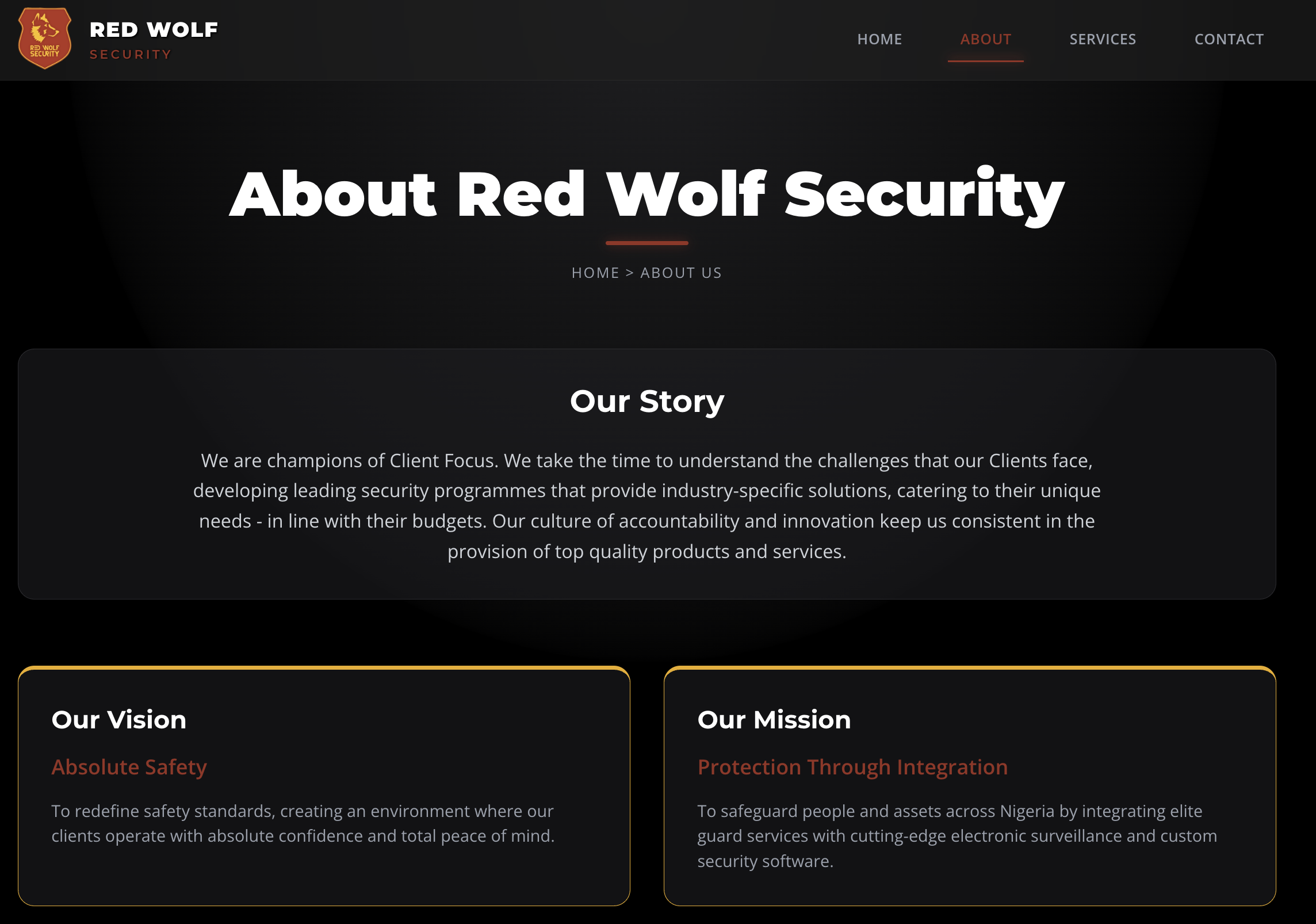
Inside the Red Wolf Security Platform
★ ★ ★ ★ ★
Testimonial being collected from the Red Wolf Security team — check back soon.
Ready to build your enterprise security platform?
Running a Security Company, Protection Services Brand,
or Multi-Vertical Safety Operation?
We build enterprise security platforms where trust, authority, and technical capability are communicated from the first second. Your digital presence should be as professional as the protection you provide. Let's build yours.