
Designing an Immersive Hospitality
Experience for the South African Countryside
Bush Creek Guest House needed more than a website — it needed a digital presence that could carry the emotional weight of a countryside retreat. A platform that made a prospective guest feel the stillness, the space, and the warmth of KwaZulu-Natal before they ever packed a bag.
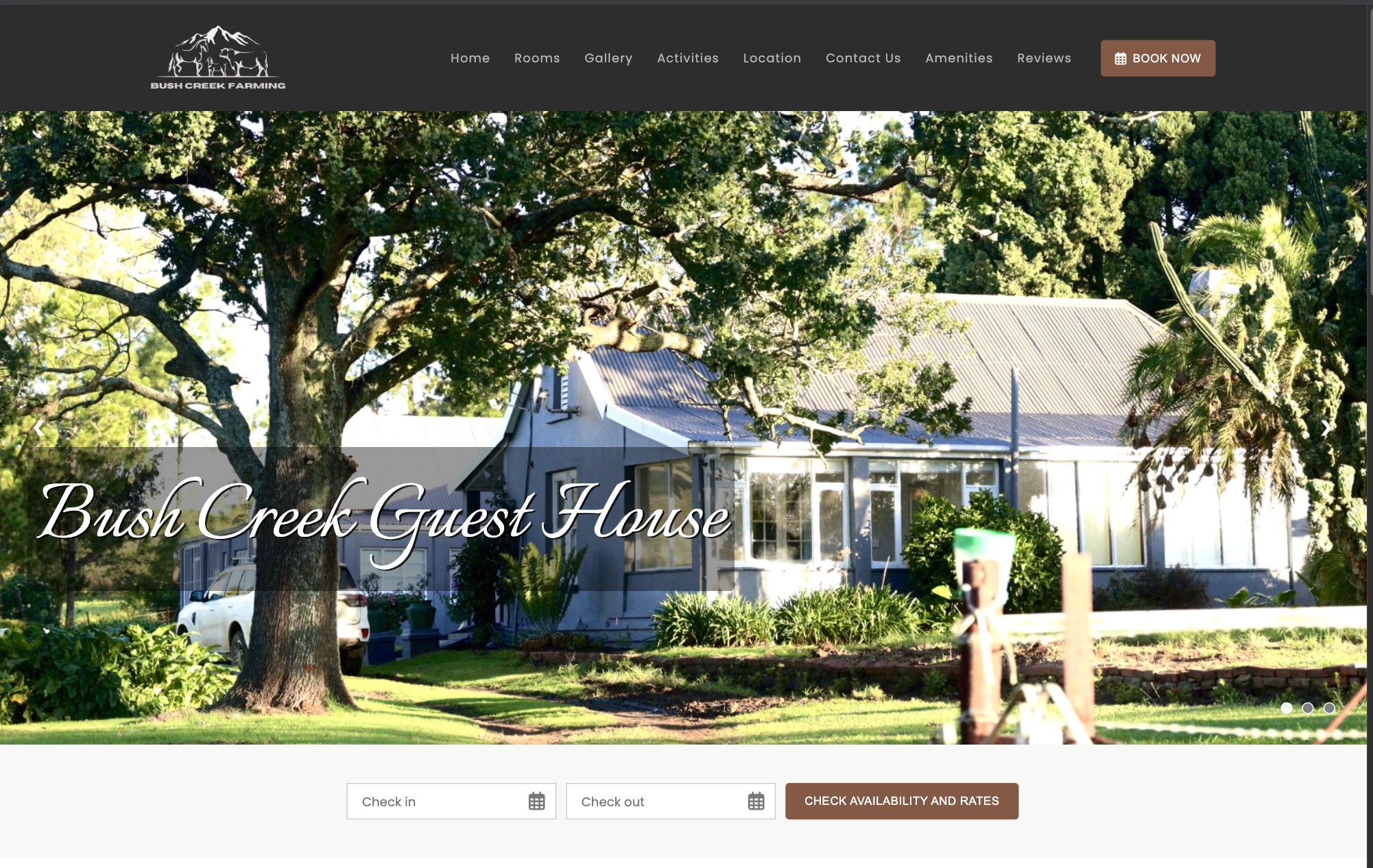
Turning a Countryside Retreat Into a Digital Destination People Feel Before They Arrive
In the South African accommodation market, trust is currency. Guests aren't just booking a room — they're making a decision about where they'll feel safe, comfortable, and genuinely welcomed. Bush Creek Guest House, a self-catering countryside retreat set between Mooi River and Estcourt in KwaZulu-Natal, had everything a discerning traveller looks for: space, natural surroundings, authentic hospitality, and the kind of quiet that's increasingly hard to find. The problem was that its digital presence didn't reflect any of that.
Nexora was engaged to build a premium hospitality platform that could do what the property itself did naturally — make people feel something. The design brief wasn't "build a website." It was "create a digital experience that converts a vague accommodation search into a confirmed booking." That required treating every visual, every content block, and every interaction as a trust-building event in a story that began the moment a prospective guest landed on the page.
- Rebuild the digital presence to match the property's premium countryside positioning
- Create an immersive visual storytelling experience that communicates atmosphere and authenticity
- Design a frictionless inquiry and booking pathway that converts browsing intent into action
- Deliver a mobile-first platform capable of performing on the varied connectivity conditions of regional South African travellers
A Property With Genuine Character. A Digital Presence That Couldn't Communicate It.
The challenge for Bush Creek Guest House wasn't the property — it was the gap between the experience the property delivered in person and what prospective guests encountered online. Accommodation decisions at the boutique and self-catering level are emotionally driven. Guests aren't comparing feature tables or price-matching against large hotel chains. They're asking: "Will I feel good there?" A website that can't answer that question visually and emotionally within the first few seconds of a visit loses that booking to a competitor that can.
Visual Trust Deficit
Accommodation websites live or die on photography and visual presentation. The existing platform lacked the immersive visual architecture necessary to transport a prospective guest — even mentally — to the property. Without a structured gallery system, atmospheric hero treatment, and deliberate visual hierarchy, high-quality property photography was rendered ineffective. The images existed, but the presentation wasn't making them work.
Inquiry Friction and Booking Abandonment
Booking intent in the accommodation market is volatile. A prospective guest who has committed enough interest to visit your website is already high-intent — but if the inquiry or booking process introduces friction (unclear forms, confusing navigation, slow load times under mobile data conditions), that intent evaporates. The challenge was not just to surface the inquiry mechanism, but to make it feel like a natural next step rather than a bureaucratic process.
Mobile Performance in a Regional Market
KwaZulu-Natal leisure travellers are predominantly mobile users, and connectivity in regional corridors is inconsistent. A platform that relies on large unoptimised images, heavy JavaScript bundles, or desktop-first layout logic will fail this audience before it has a chance to make its case. Performance engineering wasn't an afterthought — it was a prerequisite for reaching the market the property serves.
"In hospitality, your website isn't a brochure — it's the first room a guest walks into. Every visual, every word, and every interaction either builds anticipation or breaks it. There's no neutral ground."
Emotional Architecture Before a Single Layout Was Drawn
Nexora's discovery process began with a question that sounds simple but shapes every decision that follows: what does a guest need to feel at each stage of the browsing journey to move forward? The answer, mapped against the accommodation decision cycle, produced three emotional phases — curiosity, desire, and confidence. The platform's information architecture was designed to serve all three, sequentially, without interruption.
Atmosphere-Led Information Architecture
Unlike e-commerce or SaaS products, hospitality websites must lead with feeling before they lead with function. The hero section's job was to generate curiosity and desire — atmosphere, space, natural beauty. Amenities, pricing, and availability came after the emotional case had been made, not before it. This sequencing is deliberate: guests who have emotionally committed to a property are far more tolerant of the functional steps required to book it than guests who encounter those steps before they've been emotionally engaged.
Trust Signal Architecture
The discovery process identified the specific trust signals that drive accommodation decisions at the boutique self-catering level: property photography quality, amenity clarity, location context, and the ease of reaching a real person to ask a question. Each of these was given a deliberate structural position in the information hierarchy — not buried in a footer or hidden behind a navigation click, but surfaced as part of the primary browsing journey.
Conversion Flow Simplification
The inquiry pathway was reduced to its minimum viable friction. Rather than a multi-step booking system that asked guests to make decisions before they had the information they needed to make them, the flow was redesigned as a two-stage process: browse (understand the property, feel the atmosphere, assess the fit) and then connect (inquiry form with minimal required fields, surfaced at multiple points in the journey rather than locked behind a single CTA).
Our Process
Hospitality UX Research & Audience Mapping
Discovery phase focused on the KZN leisure travel market — understanding how self-catering accommodation guests research, compare, and commit. Competitor analysis across the Midlands corridor to identify differentiation opportunities.
Information Architecture & Emotional Journey Mapping
Full page-by-page structure designed around the three emotional stages of accommodation decision-making: curiosity → desire → confidence. Every section placed deliberately to advance this sequence.
Visual Direction & UI/UX Design
Visual language developed around the property's natural setting — organic tones, generous whitespace, atmospheric photography treatment. UI components designed to feel warm, inviting, and premium without feeling corporate.
Performance-Optimised Frontend Development
Mobile-first frontend engineering with lazy-loaded, WebP-optimised imagery, minimal JavaScript footprint, and CDN delivery — ensuring the image-heavy hospitality experience remained performant under regional mobile data conditions.
CMS Setup, Testing & Handoff
Content management system structured for non-technical property management — gallery updates, availability messaging, and content changes achievable without developer intervention. Full cross-device testing before launch.
Nature-Led Aesthetics in Service of Booking Conversion
The visual language for Bush Creek Guest House was derived directly from the property's physical environment. KwaZulu-Natal's Midlands landscape — grassland, water, open sky, weathered natural materials — provided the palette and the emotional register. The design system wasn't imposed onto the property; it was extracted from it. This alignment between visual identity and physical reality is what gives hospitality brands their sense of authenticity, and authenticity is the single most effective conversion driver in the self-catering accommodation market.
Colour System
Typography
Heading typography used a refined serif for property names, section headings, and pull quotes — conveying the kind of unhurried, considered quality associated with premium self-catering stays. Body copy shifted to a clean humanist sans-serif for legibility across mobile breakpoints. The combination created a visual rhythm that felt editorial and property-specific without defaulting to the generic travel site aesthetic that erases differentiation.
Design Principles
Atmosphere Before Information
Every section that leads with feeling performs better than every section that leads with facts. The hero, gallery, and accommodation sections were designed to build emotional resonance first — room dimensions, amenity lists, and pricing came after the guest had already mentally placed themselves in the space.
Photography as Primary Architecture
In hospitality, photography is not decorative — it is structural. The layout system was built around full-bleed imagery, careful aspect ratio control, and presentation formats that made property photography the hero of every section rather than a supporting element around text blocks.
Warmth Through Restraint
Premium hospitality design achieves warmth not through busy decoration but through generous spacing, careful typographic hierarchy, and the confidence to let photography breathe. Visual restraint communicates that the property doesn't need to oversell itself.
A Journey That Earns the Inquiry Before It Asks for It
The fundamental UX philosophy behind Bush Creek Guest House was that a guest should arrive at the inquiry form feeling certain, not curious. By the time a user reaches the contact section, they should have already answered their own decision questions: Is this the right type of accommodation? Does it match the atmosphere I'm looking for? Is it in the right location? Does it have what we need? The platform was designed to answer all of these questions visually and informatively before presenting any conversion mechanism.
Hero Section: The Arrival Experience
The hero section was designed to function as a digital arrival — the equivalent of pulling up a gravel driveway and seeing the property for the first time. A full-viewport atmospheric image, a headline that anchored the guest in the specific physical and emotional experience of the property, and a single clear primary action placed where a resting eye naturally falls. No navigation clutter, no competing CTAs, no information overload. Just the property, at its best, making its case.
Property Discovery: Structured Storytelling
Below the hero, the UX flow structured the property's story in the sequence a guest naturally wants to consume it: what it feels like (gallery), what it includes (accommodation and amenities), where it is (location and surroundings), and how to book. Each section answered one question completely before the next arose. Navigation between sections was smooth-scrolled and anchor-linked, preserving the sense of a continuous journey rather than a page-by-page interrogation.
Mobile: Scrolling as the Primary Interaction
Mobile hospitality browsing is fundamentally a vertical scroll experience, and the UX system was designed around this. Card layouts stacked cleanly, image galleries adapted to touch-friendly swiping, and the inquiry form collapsed to a minimal set of required fields. Reducing the perceived commitment of the initial inquiry was key to converting mobile browsers who might abandon a lengthy form in favour of the next search result.
The Systems That Transformed a Property Into a Premium Digital Destination
Immersive Gallery System
Purpose: A structured, categorised photography presentation system — exterior, interior, surroundings, amenities — allowing guests to explore the property visually in the sequence that matches their decision-making process.
High-quality property photography loses its conversion power without a presentation system that controls pacing and sequencing. The gallery turned static images into a curated visual tour, increasing time-on-site and emotional engagement before the inquiry ask.
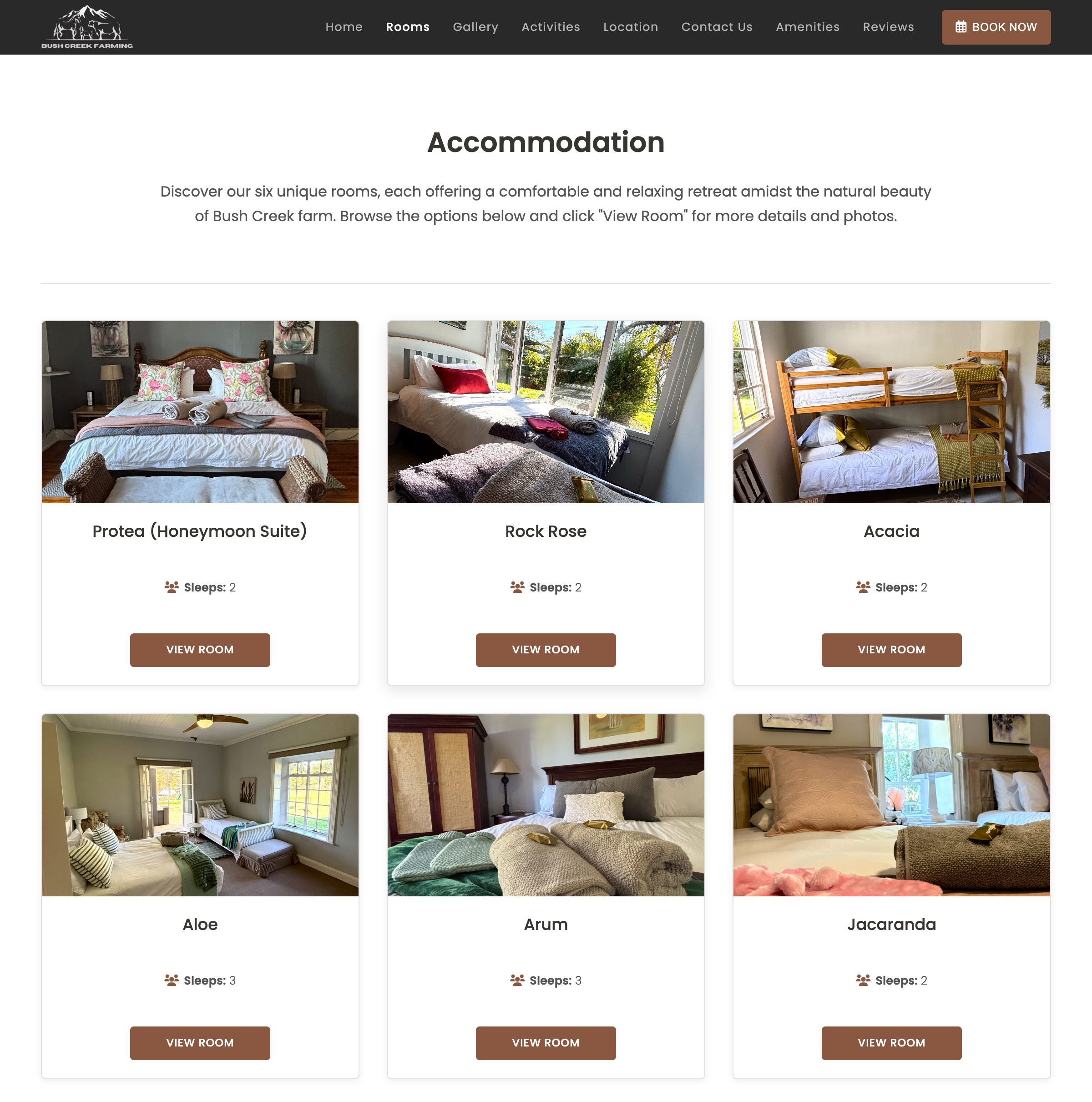
Accommodation Unit Showcase
Purpose: Individual accommodation sections presenting each unit type with its own photography, amenity list, capacity information, and character description — allowing guests to identify the specific unit that matches their group and preferences.
Generic accommodation listings lose bookings to competitors who make it easy for guests to see themselves in a specific space. Unit-level specificity converts "maybe" browsers into "this one" bookers.
Friction-Minimised Inquiry System
Purpose: A streamlined inquiry form with minimal required fields, surfaced at multiple points in the browsing journey, designed to feel like a conversation starter rather than a booking commitment.
In self-catering accommodation, the inquiry is the conversion event. Reducing friction in the inquiry form directly increases the volume of qualified leads reaching the property team.
Location & Surroundings Context
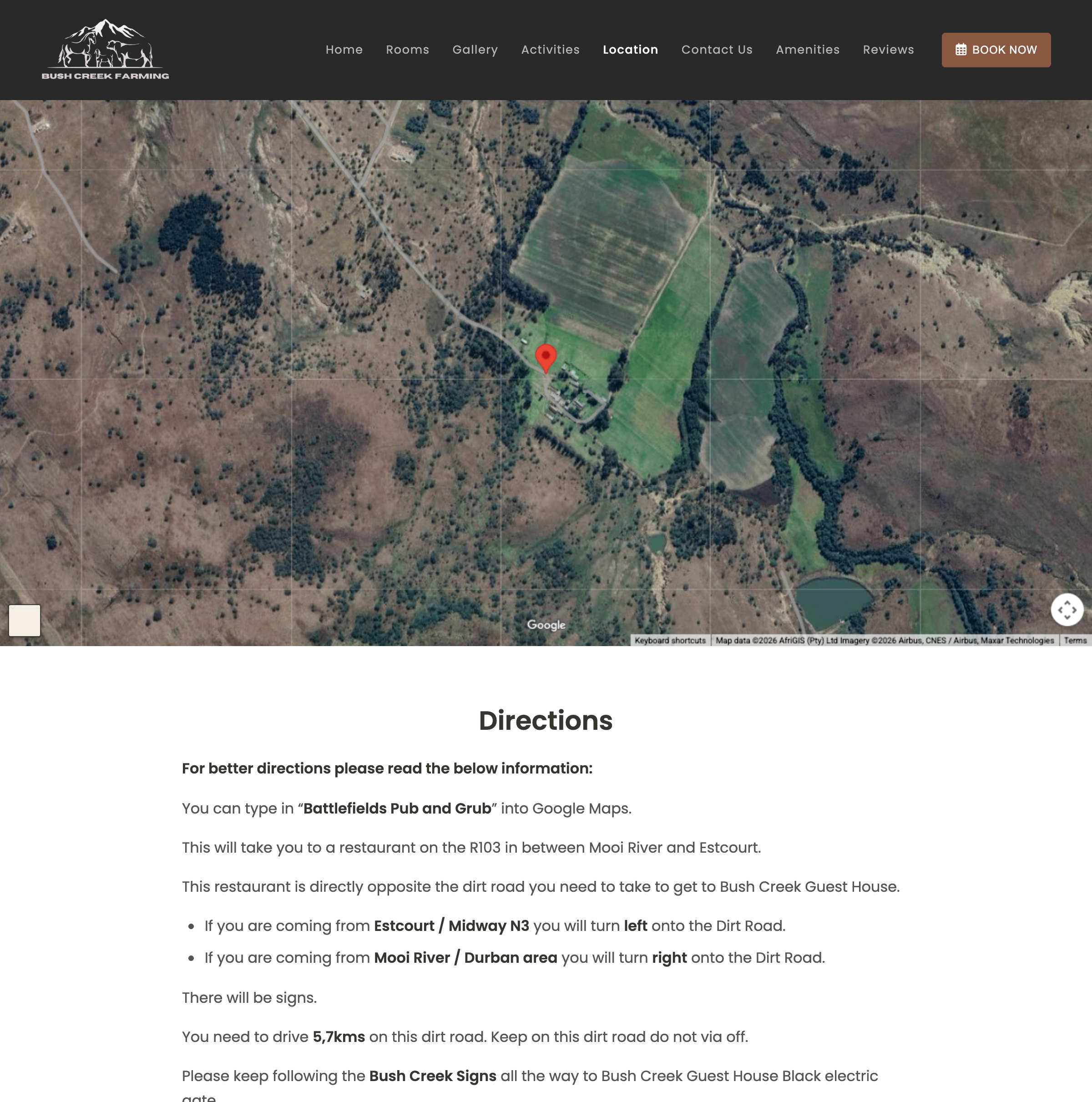
Purpose: Map integration with written context about the property's position in the Midlands region — distances to key towns, nearby attractions, route guidance, and a description of the surrounding landscape.
Location uncertainty is one of the most common reasons prospective guests abandon a booking. Proactively answering "how do I get there" and "what's nearby" removes a significant objection before it can interrupt the conversion path.
CMS-Managed Content Architecture
Purpose: A content management system structured so property owners can update gallery imagery, availability messaging, and amenity information without requiring developer involvement.
Hospitality businesses need to react to seasons, events, and availability changes quickly. A self-manageable CMS means the platform stays current without creating bottlenecks that depend on external technical support.
Performance-Optimised Image Delivery
Purpose: WebP image format delivery via CDN, with responsive srcset attributes ensuring each device receives an appropriately sized asset — full resolution on desktop, compressed but visually sharp on mobile.
An image-heavy hospitality website that loads slowly on mobile loses guests before they've seen the property. Performance optimisation is directly tied to whether the platform reaches its audience effectively.
A Lightweight, Scalable Platform Built for an Image-Led Experience
The technical requirements for Bush Creek Guest House were governed by a core constraint: the platform needed to deliver a visually rich, image-intensive hospitality experience to a regional South African audience that would primarily access it on mobile devices under variable data conditions. This ruled out bloated JavaScript frameworks and unoptimised image delivery, and placed performance engineering at the centre of every technology decision.
Frontend Architecture
- HTML5 semantic structure — clean, crawlable markup that gives search engines the property information they need to surface the site in accommodation-relevant queries
- CSS3 with custom property theming — visual system implemented without framework overhead, ensuring minimal stylesheet weight and full design control
- Progressive image loading — lazy-loaded imagery with WebP format delivery, srcset-responsive sizing, and aspect-ratio containers that prevent layout shift during load
- Minimal JavaScript footprint — interactive components implemented with vanilla JS rather than framework dependencies
Backend & Content Management
- PHP-based backend with WordPress CMS — chosen for operational simplicity, the property team's ability to self-manage content, and its robust ecosystem of hospitality-adjacent plugins
- Custom page templates designed around the hospitality content model — gallery management, accommodation unit pages, and seasonal messaging all structured as discrete, manageable content types
- Form handling with server-side validation — inquiry submissions processed reliably with spam filtering and email notification routing
Infrastructure & Performance
- CDN-distributed asset delivery — static files served from edge locations closer to South African users, reducing latency on image-heavy page loads
- Browser caching headers — returning visitor experience accelerated through asset caching strategy aligned to content update cadence
- Google Maps API integration — embedded location context with the property's exact position, nearby landmarks, and route visualisation
- Analytics integration — visitor behaviour tracking, session source attribution, and inquiry form event monitoring configured for ongoing performance visibility
Stack: HTML5 · CSS3 · JavaScript · PHP · WordPress CMS · CDN · Google Maps API · Analytics Integration · WebP Image Pipeline · Inquiry/Contact System
A Digital Presence That Works as Hard as the Property Does
Premium Brand Positioning Established
The new platform positioned Bush Creek Guest House as a considered, premium accommodation choice rather than one option among many in a generic search results page. Visual quality and design sophistication communicate the property's character to guests before they read a single word.
Mobile Experience Fully Realised
The mobile-first architecture delivered a browsing experience optimised for the primary access method of the property's target audience — regional leisure travellers researching accommodation on smartphones. Image-rich pages loaded cleanly under mobile data conditions without compromising visual quality.
Inquiry Friction Dramatically Reduced
The redesigned inquiry pathway — surfaced contextually throughout the browsing journey — and the minimal-field form structure reduced the effort required to initiate contact, increasing the volume of inbound inquiries reaching the property team.
Property Storytelling Made Scalable
The CMS-managed gallery, accommodation unit, and seasonal content systems gave the property team the tools to keep the platform current without external support — adding photography from new seasons, updating availability messaging, and expanding content as the property evolves.
Trust Signals Structurally Embedded
Location context, amenity transparency, and accommodation unit specificity were built into the platform's core architecture — ensuring the most common pre-booking objections were addressed before they could form.
Search-Ready Infrastructure
Semantic HTML structure, page-level meta architecture, and structured data implementation gave the platform the technical foundation for organic search visibility in accommodation-relevant queries — reducing dependency on third-party booking platforms for discovery.
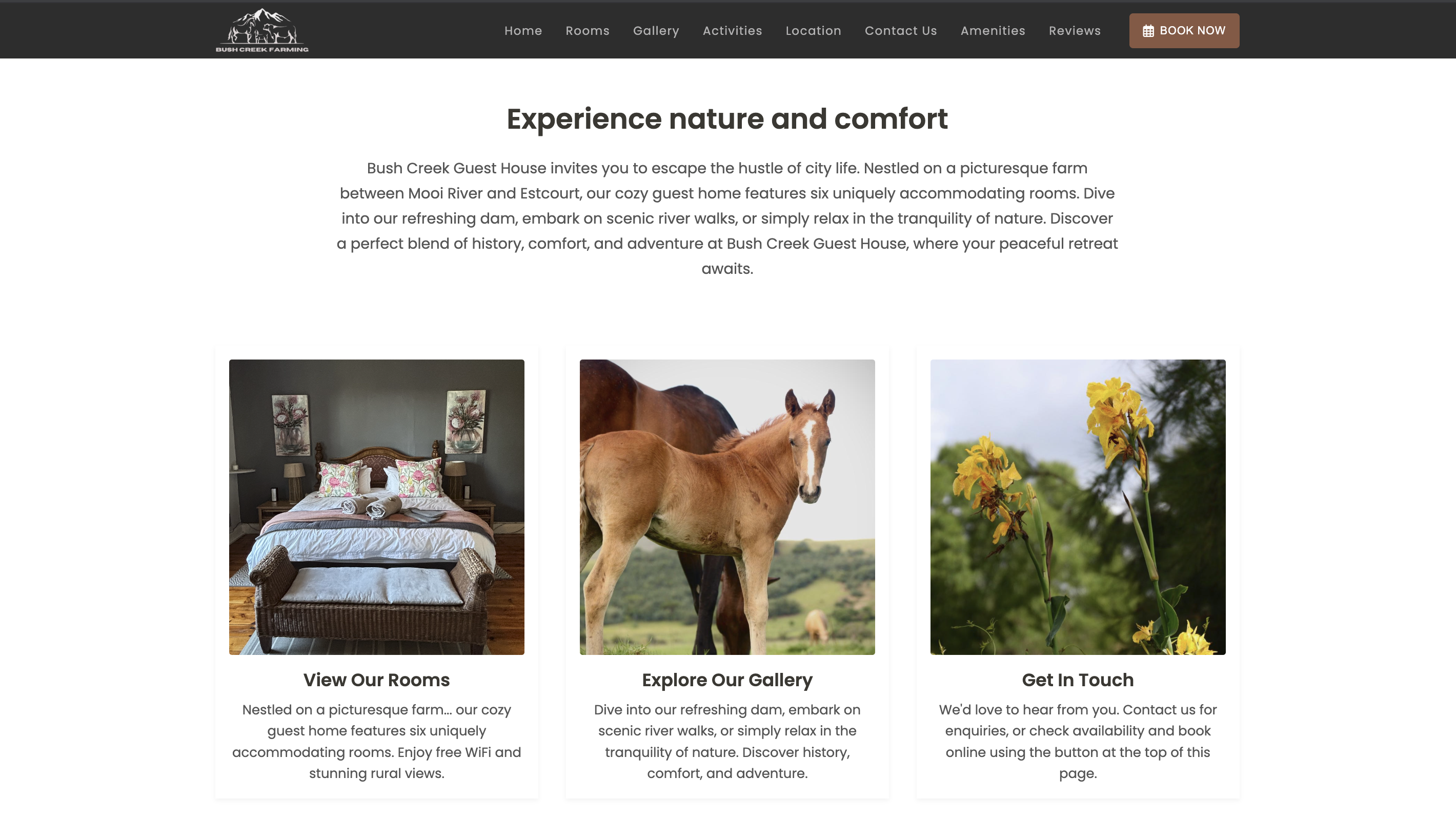
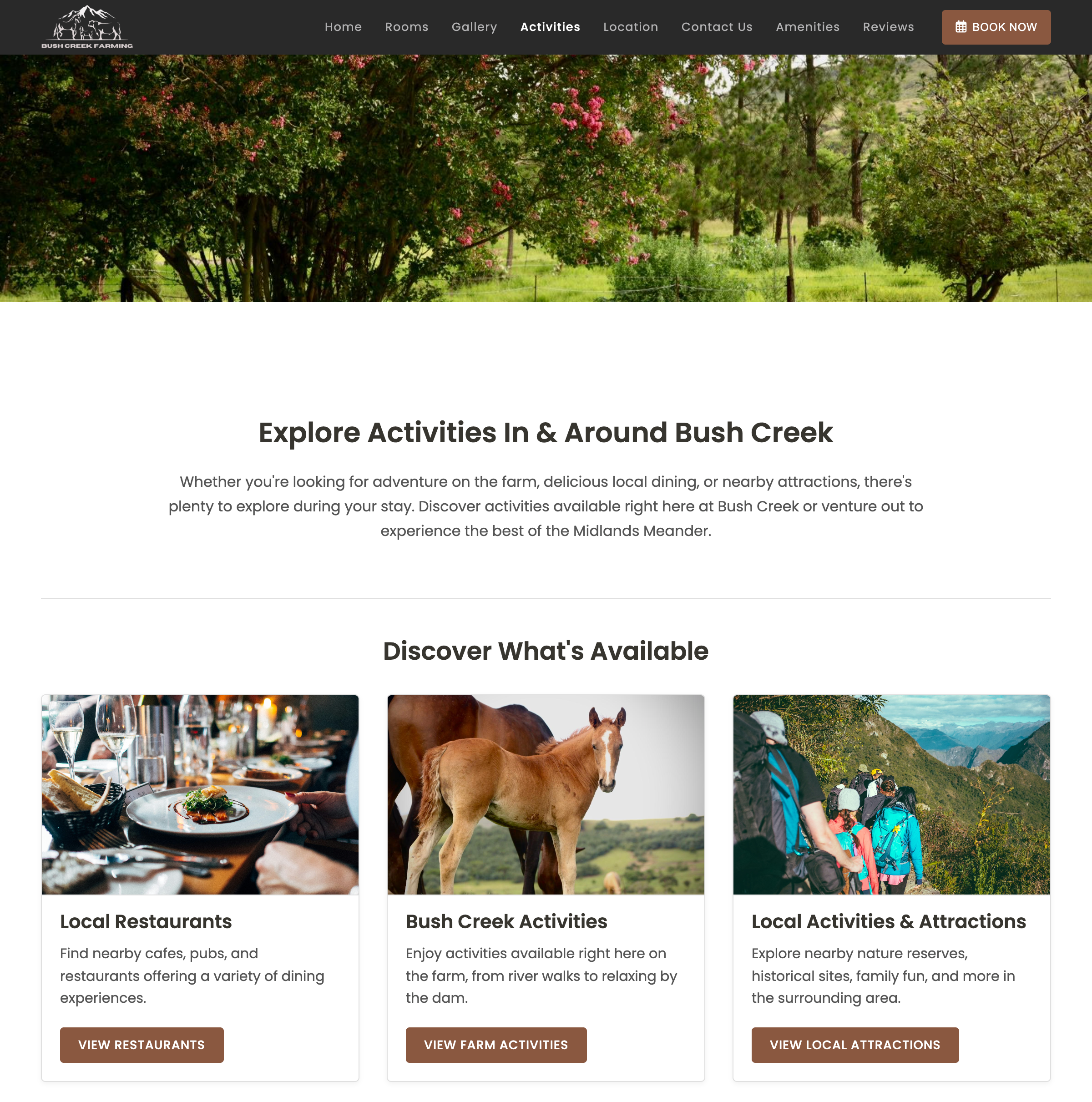
Inside the Bush Creek Guest House Platform
★ ★ ★ ★ ★
Testimonial being collected from the Bush Creek Guest House team — check back soon.
Ready to build your hospitality platform?
Running a Guest House, Boutique Hotel,
or Self-Catering Accommodation Business?
We build hospitality web experiences where every design decision serves one purpose: turning a prospective guest's curiosity into a confirmed booking. Let's build yours.